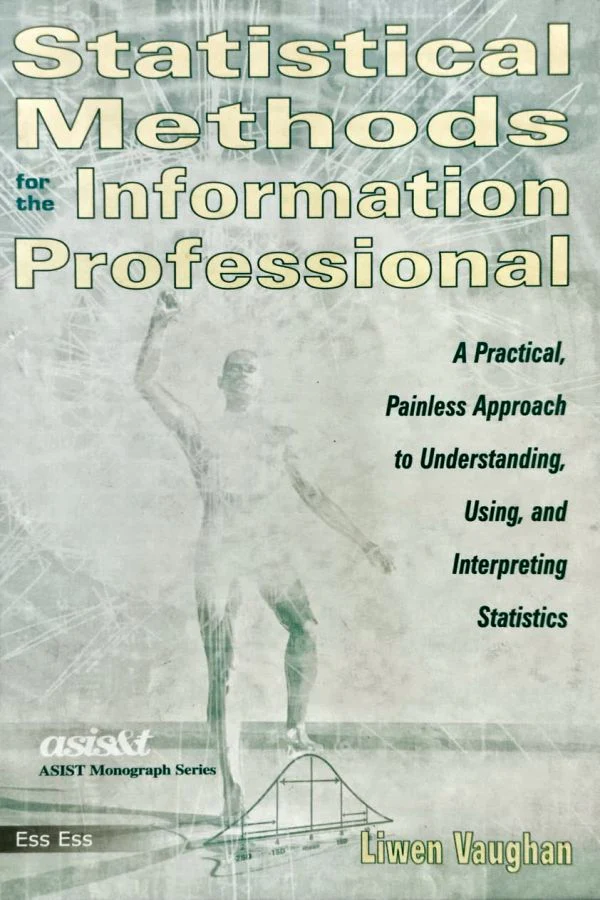
Statistical Methods for the Information Professional
Book Details
- Publisher: Ess Ess Publication
- ISBN: 9788170005520
- Year of Publication: 2009
- Language: English
- Binding: HardBound
About the Book
This book offers a refreshing and practical approach to learning statistics by focusing on understanding concepts rather than complex mathematical formulas. Designed for students, researchers, and professionals who may find statistics intimidating, it explains statistical methods through logical reasoning, real-world examples, and practical applications rather than lengthy mathematical derivations.
The author presents statistics as a powerful tool for data analysis and decision-making, emphasizing when statistical techniques should be used, how they should be applied, and how to interpret the results correctly. Instead of overwhelming readers with equations and calculations, the book simplifies statistical concepts and demonstrates their relevance through examples drawn from information science research and related fields.
A distinctive feature of the book is its step-by-step explanation of the complete research process, including hypothesis formulation, data analysis, interpretation of results, and drawing meaningful conclusions. It also highlights the growing role of computer software in statistical analysis, showing readers how modern statistical tools can perform complex calculations while allowing researchers to focus on understanding and applying the results effectively.
Written in an accessible and reader-friendly style, this book is particularly useful for students of Library and Information Science, research scholars, educators, and professionals who require a practical understanding of statistics without an extensive mathematical background.
Product Information
Product Information
Shipping & Returns
Shipping & Returns
Description
Book Details
- Publisher: Ess Ess Publication
- ISBN: 9788170005520
- Year of Publication: 2009
- Language: English
- Binding: HardBound
About the Book
This book offers a refreshing and practical approach to learning statistics by focusing on understanding concepts rather than complex mathematical formulas. Designed for students, researchers, and professionals who may find statistics intimidating, it explains statistical methods through logical reasoning, real-world examples, and practical applications rather than lengthy mathematical derivations.
The author presents statistics as a powerful tool for data analysis and decision-making, emphasizing when statistical techniques should be used, how they should be applied, and how to interpret the results correctly. Instead of overwhelming readers with equations and calculations, the book simplifies statistical concepts and demonstrates their relevance through examples drawn from information science research and related fields.
A distinctive feature of the book is its step-by-step explanation of the complete research process, including hypothesis formulation, data analysis, interpretation of results, and drawing meaningful conclusions. It also highlights the growing role of computer software in statistical analysis, showing readers how modern statistical tools can perform complex calculations while allowing researchers to focus on understanding and applying the results effectively.
Written in an accessible and reader-friendly style, this book is particularly useful for students of Library and Information Science, research scholars, educators, and professionals who require a practical understanding of statistics without an extensive mathematical background.